Tuesday, 30 September 2025

Can you plagiarise an idea?

Did Dan Brown plagiarise The Da Vinci Code?

I know it's an old story, but bear with me ...

Are you one of the 80 million or so folks that bought a copy of Dan Brown's The Da Vinci Code?  I confess to adding it as my third book in a charity shop 3 for 2 offer, so I don't think I'm included in that number.

Nevertheless, while recovering from knee surgery this time last year, I read his novel. Although panned by many critics and the intelligentsia, it is every bit the page turner you'd expect from a book which has sold in such vast quantities.

I've also read the slightly less pacey, The Holy Blood and the Holy Grail (HBHG), a non-fiction book published in 1982 which also raises the possibility that Mary Magdalene had a child by Jesus.

The authors of that book sued Dan Brown for plagiarism, citing that Brown had copied "a substantial part of the work to produce an altered copy or a colourable imitation."

Broadly, their case was not that Dan Brown had copied their text, but rather, he had copied their ideas. Thankfully, they lost their case, although it's undeniable that Brown was familiar with their work; he used an anagram of two of the authors' names for his character Leigh Teabing, who at one point in the book removes a copy of HBHG from a shelf and says: "The authors made some dubious leaps of faith in their analysis, but their fundamental premise is sound."*

There are a limited number of story archetypes.  Masterclass.com argues that there are seven, others suggest nine, the theorising is extensive, but one thing is true, authors relentlessly 'borrow', which brings me to my point.

When I read HBHG, long before The Da Vinci Code was written, it prompted ideas for my own book on the possibility of a continuation of Jesus' lineage.  I still intend to write it, although it's a long way off.  I've got as far as toying with working titles such as The Gospel Truth or The Gospel According to Mary, but given that there are over 80 million copies of The Da Vinci Code out there and Dan Brown's still bashing away at a keyboard, it might be a while before I have a crack.

That said, I recently read a story, The Ball, which one of the writers in a group I attend presented for review.  It's an account of a true event that occurred during his youth, which he felt compelled to relate faithfully.  It's an extraordinary story despite the lack of embellishment of which we authors are so often guilty.  We did encourage him to bend reality, but he remained adamant about his adherence to truth.

Unencumbered by such self-imposed constraints, his story led me to ponder where my writing would take me in a similar situation, so I borrowed elements, including the title, but placed the setting in rural Ngāruawāhia, New Zealand.  It's a different story,  but one that I would not have dredged without my fellow writer, Jack Diamond, planting the seed, and I'm grateful for the inspiration.  If you fancy reading my version, you can click on the cover below to get hold of a copy.

Book offer

It's also available as part of a wider fiction giveaway.  If you're looking for something new to read, BookFunnel is offering a range of free titles until 26 October, just click here to find out more.

To finish, I should add that having appropriated Jack's idea, I'd like to offer him thanks for not taking umbrage, and also for agreeing to let me share this with a wider audience.

Thanks too must go to all the other story-tellers that have gone before.  May their words continue to inspire the stories of tomorrow.

That's it from me, cheerio for now

Craig


* If you want to read more about the lawsuit, you can find the summary of the case which I drew upon here.

====================

Craig Brown is an author living in Newbury.  To follow his work visit craigbrownauthor.com

Facebook/BlueSky/Threads/Twitter/Instagram: @GOMinTraining
Copyright © Craig Brown, 2025
30 September 2025

Thursday, 10 July 2025

Witnessing Greatness

By Bahnfrend - Own work, CC BY-SA 4.0, https://commons.wikimedia.org/w/index.php?curid=64002793
Photo credit: Bahnfrend, CC BY-SA 4.0

Near where I live, to the south of Newbury, on the fringe of Wash Common, stands the Falkland Cricket Club, with its fabulous pavilion, The Bowler's Arms.  It's a cherished community hub and a testament to the people who have poured time and energy into making it a glorious venue.

The dedication of the club to fostering and supporting talent has led it to maintain its wicket to County standards, ensuring that the playing surface is fit to host first-class matches.

Once a year, the club hosts a Vitality Blast match, one of the highest forms of T20 cricket in the country.  On 9 July, the Hampshire Hawks women's team played the Lancashire Lightening.

With the England team playing India that same day, both teams' squads lacked their current England stars, however, one name on the scorecard stood out, and made the modest entry fee even better value for money.

Unless you are a fan of cricket, the name Ellyse Perry may not mean much to you.  If you are, you will know that she is one of the world's best players, an Australian international and a genuine all-rounder, boasting impressive batting and bowling stats in all forms of the game, including the highest Test score for an Australian woman of 213 not-out, against England.  A lesser-known fact, is that she also played football (soccer) for her country before settling in to become a full-time cricketer.  She is an extraordinary sportswoman.

Alas, the hoped for batting display didn't materialise, as Perry was freakishly run out with just one run to her name and before I'd settled in to watch the game.  When it came to her bowling, she had an off day, conceding 24 runs in two overs, including a couple of wides.  For her, it was a forgettable day.

What struck me though, is how she responded to the set back.  At the end of the game, having suffered an ignominious defeat, most of the Hampshire players retired to the pavilion or spent some time on the outfield chatting to fans and signing autographs.  One player alone did something different.

Ellyse Perry found a coach, a set of practice stumps, and an unused playing strip and proceeded to bowl ball after ball, refining her craft.  Few people watched her, the activity wasn't to garner a crowd.  I suspect her sole focus was addressing the deficiencies she felt in her performance; it was a masterclass in striving for perfection.

It was the barest glimpse into what it takes to be an elite athlete; going that bit further than others are willing to go to be the best.  Although I didn't get to see her dominate with the bat, or decimate the opposition with the ball, it was a privilege to witness an element of the determination that it takes to be one of the leading competitors in world sport.  For me, that was just a little bit special.

Cheerio for now,

Craig

Ellyse Perry stats

Hampshire v Lancashire scorecard

Photo source

====================

Craig Brown is an author living in Newbury.  To follow his work visit craigbrownauthor.com

Facebook/BlueSky/Threads/Twitter/Instagram: @GOMinTraining
Copyright © Craig Brown, 2025
10 July 2025


Friday, 25 April 2025

In search of authenticity

One of the questions I'm most often asked by people curious about the writing process is,  "How much do you plan your novels?"  When I give the answer, I'm often greeted with incredulity, because for me, the direction of travel is not one that I'm particularly mindful of when I set out to write.

It's said that there are two types of writer, the 'plotter' and the 'pantser' (other descriptions are available).  John Irving, one of my favourite writers, is a plotter.  In interviews, he's stated that before he begins writing one of his works, he prepares a detailed treatment of how his book will unfold.  Those treatments, he says, can extend to over two-hundred pages and map the story from start to finish.

Other writers, myself included, are pantsers - we write from the seat of our pants.  When I start something, I have a vague notion of where I'm going, but often along the way, I discover that my final destination is different to that where I thought I'd arrive.  For me, this can lead to highly satisfying outcomes, the story is often better than the one I originally conceived and the process of discovery is mightily enjoyable.

Whatever route an author takes, the prevailing advice from those with more experience than me, is to get the damn words onto paper.  In her book, 'Bird by Bird', an excellent book on the craft of writing, the American novelist, Anne Lamott, talks about "shitty first drafts".  It's the principle of getting words down without being too encumbered by what they might be like.  There is an editorial process that follows and over the course of iterations, any issues that exist in the first draft will be addressed, improving the overall work.

What such an approach permits is the unfettered deposit of the vague onto the page.  It allows the uninformed to write whatever they like, safe in the knowledge that if it is a pile of the brown smelly stuff, it can be improved with input from those that know better.  It means that the stream of words is unhindered, the premise being that one will write more fluidly allowing the story to flow.

During the editorial process, the writer can revisit the liberties exercised due to ignorance and replace them with something notionally more realistic.  In a chapter in my forthcoming novel, 'Dignity', I included a scene that involves a fire.  There were certain things I wanted to happen that I suspected might be incompatible - a blazing inferno coupled with an improbable outcome.  While I knew that what I was writing was flaky, I nevertheless wove it into the manuscript, hoping that my grasp on reality wasn't too far removed from the laws of physics.

Believe me when I say that it was.  It was so far removed from the nature and outcome of a fire as to be laughable.  I know this to be true, because when I contacted my local Fire Service and shared it with the Station Manager, laugh is exactly what he did.  I suspect he thought he was dealing with an idiot, and given the unadulterated fantasy on the page, he may have had a point.

What I wasn't prepared for, however, was the assertion that what I'd written was insulting to the fine men and women of the Fire Service who serve to keep us safe.  I'd had the temerity to suggest in my scene that, post-fire, some of those that had wrestled to bring the blaze under control were now enjoying a lively gossip while other colleagues cleared up.  My Station Manager was firm, "None of my team stand around chatting.  No one stops until the work's complete."  My inadvertent slight was easy to correct, however, some of the challenges relating to the fire and the outcome required inventiveness.

With the patience that one reserves for the hard of learning, he took me through a number of plausible scenarios, each one greeted with a question from me that would enable my scene to better fit the plot.  He prefaced each answer with a grimace and the words, "You could ..." before telling me exactly why I couldn't.  Eventually we arrived at a compromise that didn't entirely undermine his decades of knowledge and I had material with which I could work.

As we were drawing to a close, the station's klaxon sounded, announcing an emergency.  I suspect he had never been so pleased to hear it.  "Do you need to go?" I asked.
He peered into the corner of the room, listening intently, "Not sure," he said.
An indecipherable announcement came over the Tannoy.
"Yep, gotta go," he said, before leaving the room.

I remained where I was, quite unsure of what to do.  After a moment, he popped his head around the door to find me still sitting in front of his desk.  "Do you know how to find your way out?" he asked.
"Ah, yeah.  I'll be fine."
"Okay," he said.  "Oh, and if you were planning to, I wouldn't take the A34 home."

And with that, he left along with his team to perform whatever heroics were required, while I left with the material I needed to write a much better book and the satisfaction of having had a private tour of my local fire station - next time I might ask him to let me sit in a truck.

Cheerio for now,

Craig

Before I go, a 'by-the-by'.  In a couple of months, part one of my serialised novel, 'A Little Something To Hide', will be celebrating its first birthday.  Over a series of weeks, I'll be making each of the volumes freely available to Kindle users in my Readers' Club for a limited period.  If you'd like to take advantage of the offer, click on the link where you can sign up directly or grab a copy of my free short story, 'The First Supper'.

====================

Craig Brown is an author living in Newbury.  To follow his work visit craigbrownauthor.com

Facebook/BlueSky/Threads/Twitter/Instagram: @GOMinTraining
Copyright © Craig Brown, 2025
25 April 2025


Friday, 28 March 2025

A wee hiatus

It’s been a while since I last wrote, almost two months, however, much has happened since then.

Most notably, Mrs B and I disappeared to New Zealand for a break and the opportunity to catch up with friends and family in what proved to be an indulgent month. A visit to my homeland isn’t entirely a holiday, although other than maintaining a journal of our trip, I confess to writing little.

It’s always great to go home (the notion of home being interchangeable depending on which country I’m in), if somewhat exhausting. In our final ten days, we stayed in eight different beds and drove many miles in between those resting spots. That, however, was a small price to pay for fabulous stays with friends from my youth.

We top-and-tailed the excursion to NZ with visits to Dubai and Singapore, the former affording us a long overdue reunion, the latter giving us the opportunity to explore somewhere new (although I did visit Singapore as a ten-year-old, but back then, I viewed the place with a somewhat different, Scalextric obsessed, perspective).

It is on this last destination that I wish to dwell. Singapore is a melting-pot of different ethnicities and cultures, seemingly living alongside one another in harmony. In a few square kilometres one can find great temples and monuments to Christianity, Islam, Hinduism and Buddhism, each faith prominently represented.

We had the opportunity to visit mosques and temples and experience ceremonies with which we were unfamiliar. We never felt unwelcome and when we sought to understand more of what we were witnessing, we readily found someone willing to share their knowledge and faith.

At the Sri Mariamman Temple, Singapore’s oldest Hindu temple, we had the great fortune to arrive during a ceremony that celebrated a couple’s marriage on the occasion of the husband’s 60th birthday. Fabulously adorned in traditional dress, the guests paid homage to the couple as the Pujari led the service, while musicians played the shehnai (similar to an oboe) and dholak drums, lending vibrancy to the event.

Our experience led me to wonder what it is that nationalists find so frightening or offensive about other cultures. What we witnessed was a joyous celebration of a couple’s love for one another. Neither the ceremony nor their faith was imposed upon us, we were the interlopers, willingly accepted into their place of worship. For us, it was a fabulous experience and one that we felt privileged to witness. When we left, we took with us our memory of the event and a feeling of general wellbeing. No one made us feel uncomfortable, nor did we gain a sense that the Hindu faith posed any threat to ours.

I suspect that if we visited a similar place of worship in the UK we’d be made to feel equally welcome and equally free to leave with the choice to continue exercising our existing way of life. Alternatively, if we wished, I’m sure we could embrace their culture – I even suspect that adopting a bit of both might not be mutually exclusive.

What our visit to Singapore has taught me is that different ethnicities, cultures and faiths can happily co-exist. The presence of a mosque or a Buddhist temple on our city’s streets does not imply an attempt to subvert existing Christian or Jewish faiths. Experiencing a festival such as Diwali should be viewed as an opportunity to experience other people’s culture, hopefully to be enriched and certainly not contaminated. One can walk away safe in the knowledge that one’s culture is preserved – Christmas won’t be cancelled.

The risk that nationalists express, that immigrant arrivals from other countries will undermine our culture, is nonsense. The failure to celebrate our own, and invite others to enjoy it, is more damaging to the fabric of whatever it is that makes for Britishness. Inviting a visitor to England to dance around a maypole, or have a slice of victoria sponge at a street party celebrating a royal wedding, will do far more to preserve UK culture and encourage newcomers to assimilate. But equally, it doesn’t matter if they don’t – I’ve Morris danced once, that was enough. Extraordinarily, despite my unwillingness to participate again, the practice continues.

Somewhere within my experience is a story waiting to be told. Perhaps it’s of a curmudgeonly old man who despises foreigners but learns not to fear and loathe them after receiving acts of kindness from the people he detests. Maybe there’s a tale of a terrified refugee who discovers that she is welcome in the place where she has arrived, or even the story of a man whose experiences make him feel comfortable to call two countries home. It’s something to ponder.

PS - In the Morris dancing clip, I'm the ridiculously smiley bloke who starts the dance second from the left.

====================

Craig Brown is an author living in Newbury.  To follow his work visit craigbrownauthor.com

Facebook/BlueSky/Threads/Twitter/Instagram: @GOMinTraining
Copyright © Craig Brown, 2025
28 March 2025


Tuesday, 28 January 2025

What's the hardest part about writing a book?

When I first set out on my adventure in penmanship, I agreed with my wife that I'd give it a year to see how it panned out.  We figured, that if I wasn't a raging success after twelve months, it was unlikely ever to happen.

Looking back now, I do so with a fondness at the naivete, albeit that fondness is tempered - there is still so much that I have to learn.  In March, it will be six years since I said cheerio to a world that included a steady income, regular (if long) working hours, and the certain knowledge that the world would remain largely untroubled by my presence.

Two of those things have changed, the one that remains resolutely fixed, and the one I most need to alter to achieve success (note the dropping of the adjective, at this stage, 'modest' would be a more than adequate modifier), is for a small corner of the world, populated by those that enjoy reading literary fiction, to notice that I've popped a book they might like onto the market.

I spend less time on social media these days, but when I allowed it to fully exercise its distractions, I spent much of my time reading the posts of fellow authors, many of whom are independently published.  I read less of their musings now, not because I don't enjoy what they have to say, but because I experience a degree of guilt from reading what they freely share through the digital ether, rather than buying and reading the books that they're trying to promote.

One of the writers I followed on X shared her book sales daily, expressing her most enthusiastic joy whenever she topped sales of one hundred copies, a feat she often achieved.  Before my own book came out, I condescended to think, "Bless her.  She's giving it a go."

I now know that to be a thought smothered with hubris.  What I wouldn't give to hit triple figures of daily sales.  In fact, I'd be happy just to hit triple figures!  Which brings me to my point - selling books is hard!

That reality is a slow dawning realisation and one with which I'm wrestling, often at the expense of doing that which I most want to do, writing.  There are no end of services available to authors for promoting their work - my Messenger feed is full of people willing to help; for a price and a vague promise.  I haven't yet found one who is willing to promote the book for a share of future royalties - their belief in their services (or my work) doesn't stretch that far.

There are other routes that I've explored, mostly with mediocre results.  Amazon and Facebook ads, direct approaches to booksellers, third-party services that marry readers with titles, and review services.

This last is the one that I'm enjoying the most - not because they're contributing greatly to sales, the truth is more narcissistic.  It's because each review carries a hint of validation.  I've been thrilled with the critiques, which to date are universally positive.  If you fancy taking a look, you can read them by clicking on the logos down below.

I am hoping that at some point, I will experience that mysterious moment that Malcolm Gladwell writes about in his book 'The Tipping Point', where a threshold is reached that leads to some form of critical mass.  His book is a brilliant read, but not one that tells me how to go about finding that vast audience for my book.

Notwithstanding the above, I'll keep plugging away and eventually spend more time on bringing my next novel to market.  The pleasure that comes from that process does a great deal to offset the frustration of not being a great bookseller.

Thanks for humouring me - I'm grateful that you're along for the ride.


====================

Craig Brown is an author living in Newbury.  To follow his work visit craigbrownauthor.com

Facebook/BlueSky/Threads/Twitter/Instagram: @GOMinTraining
Copyright © Craig Brown, 2025
28 January 2025

Tuesday, 31 December 2024

A resolution I plan to keep

Happy New Year!  I hope that 2025 contains everything that you're hoping for and that you stick to your resolutions.

I have a confession - I'm not terribly good at keeping mine.  As age assails me, the ambition attached to resolutions is more modest than in the past.  This year, I'm aiming to deliver on my promise to myself, which is knocking my next novel into submission-ready shape.  In writing this, however, I'm procrastinating over the edits of the fourth draft of what is one of my longer running projects.

Back in 2003, I travelled from New York to Los Angeles for a meeting with a potential client.  Three things stuck with me from that trip. The first was a conversation that I earwigged in Starbucks when I got to California. I heard the lament of a woman explaining to a friend everything that was wrong in her life.  Appreciating that I was listening to an intensely private conversation, I tried not to pay too much attention, albeit, the volume of their discussion made it difficult to ignore.

Before long, the catalogue of misery drew to a close and the listener took hold of her friend's hands and mustering an admirable degree of earnestness, she diagnosed the issues.

'Your problem,' she said. 'Is that your planets are not aligned.' She then proceeded to explain the influence of the cosmos on her friend's life, citing the solar system as the reason for the turmoil.

In response to those pearls of wisdom, the other woman said, 'I know you're right, but I can't help thinking that maybe it's something to do with me.'

Reassurance came quickly in the form of absolution from all personal responsibility.  Celestial bodies were entirely to blame.

On reflection, I take heart from that conversation. I now know that the 142 unsuccessful submissions that I made last year were not due to any inadequacies on my part.  Rather, the primary reason I failed to secure an agent was Jupiter's proximity to Uranus.

That's good to know and a blessed relief.

The second event that etched its way into my memory occurred during the meeting. It was a largely pleasant affair, which opened with the announcement that our client was happy to accept our proposal, subject to what she considered to be some minor adjustments.

A large table stood in the middle of an impressive space, floor to ceiling windows offered views of the Los Angeles skyline. We sat on opposite sides of the table and prepared for our negotiation - I armed myself with laptop, notepad and pen - she carried a single sheet of paper and an oversized handbag of an almost luminescent pink shade, which she positioned on the table to her left.  Between us sat a coffee jug and biscuits.

Our skirmishes around contract terms and conditions were agreed to mutual satisfaction, save for one - payment terms. Coming from a company where cashflow concerns were a constant reminder of our fragility, the ninety days that her company wanted represented a crippling risk to us. With the knowledge that my CFO's desired outcome was thirty days, I chanced my arm, asking for fifteen.

A tension emerged that hadn't before existed. My client shifted uncomfortably, and I detected something guttural coming from her side of the table, as though she was clearing her throat for a menacing riposte. 'Pickle,' she said.

'I beg your pardon?'

She didn't repeat herself, instead saying, 'We definitely can't do fifteen. I can offer you sixty.'

Sixty days still represented too great a price to us. I countered again, explaining our challenges as best I could without revealing the inherent weakness of our business.

'How about three weeks, twenty-one days?'

This time, there was no mistaking the sound; high-pitched, somewhat strangled, and unmistakably a growl.

'I know my manager won't agree to that and I'm not sure Pickle likes your offer either,' she said, smiling.

The handbag appeared to move a fraction, although she seemed neither to notice or care. 'I'm authorised to accept forty-five days. We'd be good to go with that.'

I confess to being a little unnerved, not with the negotiation, but with the seemingly sentient handbag. Despite my unease, I knew I'd get sign-off at that level, but tried once more. 'Thirty days?'

She shook her head, whereupon the handbag lurched and a head popped out, and Pickle, the chihuahua, yapped at me. 'I guess that's a "No" from Pickle,' I said.

My client nodded, once more giving me the option to agree to forty-five day payment terms, which I accepted, whereupon Pickle wrestled herself from from the handbag, waltzed to the middle of the table and helped herself to a biscuit.

The third thing I remember, which preceded the others, was writing the opening chapters of the novel that I'm in the process of editing.  At 35,000 feet above Decatur, Indiana, I began writing 'Dignity'.  By the time my plane was passing Champaign, Illinois, on route to Long Beach, the first chapter was nearing completion.  It's over twenty years in the making, but the novel is getting closer to its final shape.

It's inspired by the Deacon Blue song of the same name, and if you click on the cover art above, you can hear the song.  Pay close attention to the lyrics, somewhere within lies the story.  I can't wait to bring it to you, along with a fresh cover designed by someone far more creative than me.

That's it from me, until next time, enjoy the song.

Craig

PPS - The image of 'Pickle' is courtesy of Oleg Gapeenko, https://www.vecteezy.com/members/gankogroup and the image depicting the planetary influence on my submissions came from https://stockcake.com/i/planets-in-harmony_1565975_1183838

====================

Craig Brown is an author living in Newbury.  To follow his work visit craigbrownauthor.com

Facebook/BlueSky/Threads/Twitter/Instagram: @GOMinTraining
Copyright © Craig Brown, 2025
1 January 2025


Tuesday, 3 December 2024

A day for reflection

Today's a quiet day for me, one where I contemplate the past.

Were they still alive, my parents would be celebrating their 64th wedding anniversary today, but we lost them too soon.  My father died, aged 49, in 1983 and my mother passed in 2004 shortly after her 66th birthday.  I don't mention that to garner sympathy, merely as an observation of one of life's inevitabilities.

I could be disingenuous and pretend the cliché that not a day goes by that I don’t think of them. Whilst I might like that to be true, it simply isn't.  When I do think of them, which is often, I feel a depth of loss which I suspect is shared by those who have said goodbye too early to those that they love.

I believe I cope reasonably well with grief.  I'm not one to bottle my emotions; I don't see any weakness in a man crying.  Hugs possess magic in both the giving and receiving; there is a power in sharing one's feelings.

To help me cope, I often pick up a pen, writing with an intensity that I don't experience in my day-to-day endeavours.  What emerges is much more raw and sometimes difficult to digest.  After my mother's death, I spent a ten-day period drafting what has now become a short memoir.

In 2009, it was my first effort at self-publishing.  I sold about nine copies, five of them to myself.  I'm not sure there was (or is) a market for what I had to say then, just as there may not be now.

That said, my daughter recently read what I wrote and reminded me that I'd written a lovely piece.  It's intensely personal, but it is a story that I'm willing to share in the hope, which may be misguided, that it might provide comfort to a reader that feels the need for a literary hug.

Together Again is the briefest of portraits into the experience I had at the time of my mother’s passing.  It explores her battle with cancer and the helplessness we felt.  It journeys through our despair, our shared laughter and hope, and when the inevitable arrived, the love that engulfed us.

This isn't for everyone, it's not even a pitch to encourage you to read it.  But if you, or someone you know is struggling with grief, it may help you to know that you're not alone.

=============

Craig Brown is an author living in Newbury.  To follow his work visit craigbrownauthor.com

Facebook/BlueSky/Threads/Twitter/Instagram: @GOMinTraining
Copyright © Craig Brown, 2024
3 December 2024


Tuesday, 19 November 2024

The words are out in the world ...

... and they no longer belong to me.

I don't know who said that, might have been me, could have been any number of authors whose books finally get published.

It's the realisation one experiences when a book is released into the wild; when it ceases to belong to the writer and is in the hands of a reader and their interpretation of the words.  It's that moment when the imagination of someone else is applied to the story - the landscape, the look of each character, the nuance implied in the language; they might spring from the page into someone's head as something completely different to that intended.

A Little Something To Hide publishes today, 1479 days after the first word hit the page.  On that first day, 1 November 2020, in response to the call of NaNoWriMo, I wrote 356 words.  Not many of those survived to the tenth and final draft.

Stacked on my desk is a pile of books measuring 46 centimetres, representing the various iterations that led me to the point I've reached today.  I thought it was ready with the one sitting at the bottom.  An array of folks suggested otherwise, offering kind words and correctives, indicating that perhaps I needed to work the manuscript a little harder; restructure the narrative, hone chapters, drop passages, re-engineer some of the stories.  Not all of it was easy to hear, but every piece proved valuable in some sense, leading, I hope, to an improved outcome.

Obviously, I'm not the one to judge that, my opinion might be influenced by just a shade of bias.  If pushed, however, I would suggest it's a bloody good read - one of the best books hitting the market in 2024.  Possibly even, the Christmas present for which you will receive the highest degree of praise and thanks.  Just imagine the kudos you'll get for being the one to introduce someone to such a treasure.  I'll leave you to dream.

Alternatively, I could make the dream a reality by telling you exactly where you can get hold of such a gem.  It's available at all good bookstores named Amazon and you can get it by clicking HERE.

If, however, you are minded to support independent booksellers - and there are few nobler causes - you could pop into your local book shop and ask for a copy.  If they're out of stock, they'll be able to order a copy to arrive in a few days.

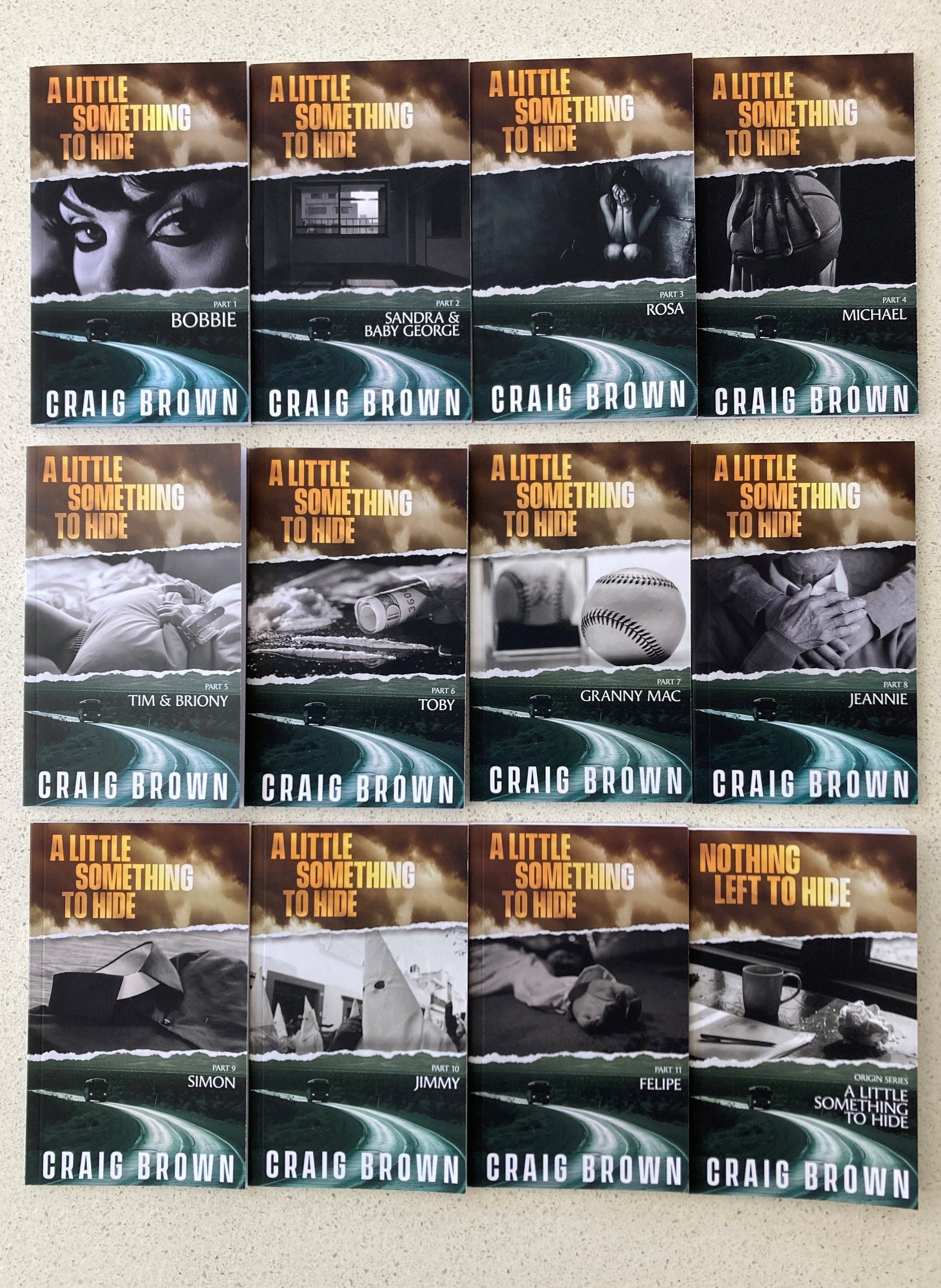
There's also a companion piece that goes with it, exclusively on Amazon, called Nothing Left To Hide, which provides insights into the motivation behind the book and each of the characters.  It's full of spoilers, so don't sample that before you've read the main book, unless you're one of those barbarians that reads the final chapter of a book first - why, oh why!  I blame the parents.

Whatever the case, I'd love you to grab a copy of A Little Something To Hide and join the passengers on the road to Albuquerque.  You might recognise some of the people you're sharing the bus with and be delighted you're travelling together.  Others, you'll hope, will never have the opportunity to sit alongside you again.  Either way, you might find yourself in for a little surprise.

Thanks for reading, I hope you'll climb aboard.

Craig

=============

A Little Something To Hide

Some people want to take their secrets to the grave.
On the Briscola Coach Service to Albuquerque, that’s just not possible.

A Little Something To Hide is an exploration of the human condition.  Every traveller on the Briscola Coach Service believes they’re harbouring a secret that none of the world can see.  Some secrets are darker than others and none of them are truly hidden.  Climb aboard to learn more and remember, never trust the person you’re next to, no matter how sweet they look.

“... remarkable insight into the lives of these characters, aptly portraying the impact on those characters and their various reactions to the abuses they have suffered.”

Maureen Kelly, Reedsy

=============

Craig Brown is an author living in Newbury.  To follow his work visit craigbrownauthor.com

Facebook/BlueSky/Threads/Twitter/Instagram: @GOMinTraining
Copyright © Craig Brown, 2024
19 November 2024


Tuesday, 12 November 2024

The end is nigh ...

... and no, I'm not talking about that thing that happened a week ago in the US.

Instead, today's note is about the conclusion to A Little Something To Hide, which as you may know, I've been serialising over the past five months.

Felipe hits the shelves today and his appearance brings to an end the journey from San Francisco to Albuquerque.  I'm not a fan of travelling by coach, but this journey's been different, my fellow passengers have been quite candid about their revelations.

I'm not going to say too much about Felipe here, suffice to say he's one of the 47.8 million foreigners living in the USA today, almost a quarter of whom are undocumented migrants.

When conducting my research into migration to the States, I discovered an interesting snippet of information - undocumented migrants paid $96.7 billion in federal, state and local taxes in 2022, a third of which goes toward funding programmes that they're barred from accessing.  All I'll say about that, is that perhaps a little maths might be useful before too many scream about mass deportations.

To an extent, A Little Something To Hide represents my observations of modern America, which allowed me to explore injustice in multiple guises – fairness often took a seat toward the back of the Briscola coach, possibly because my normally optimistic view of the world disappears when I turn on the news or browse my social media feeds.  At times, it seems as though we’re overwhelmed by the greedy and the cynical, is it any wonder then, that elements of nastiness should make an appearance on the road to Albuquerque.

As an escapee from the Medellín Cartel, Felipe's story reflects the lives of other immigrants arriving in the US for a better life.  As a counter to the narrative that so often spews ill about what the immigrant population brings to a country, I wanted Felipe to be mostly harmless, to exist as no threat to anyone that enters his domain.  He is entirely benign, save for ... well, you'll have to read the book to find out.

Felipe’s story is not an isolated one and despite the hate that is often directed their way, most migrants are hard-working, law-abiding citizens, who contribute to the great diaspora that has shaped the American landscape for generations, and which makes it the rich and vibrant country that we see today.

America has its issues: a polarised nation, extreme gun violence, eye-watering wealth and income inequality, a lack of affordable healthcare for many, and drug addiction to name a few, but it remains an exemplar to many.  Over hundreds of years, peoples from many nations have flocked to the country in search of a better life and the opportunities that few countries are better positioned to provide.  It is a genuine melting-pot, a place like no other, yet how sad is it that inter-generational memories are so short, that those whose ancestors migrated to the country should be so afraid of those that follow in their footsteps.


A Little Something To Hide: Part eleven - Felipe

Felipe was a waif when he fled his home in Medellín to cross the border at Antelope Wells, escaping the cartel’s newly emerging leader.  In the US he embraces his new culture, indulging in a quiet life of fast-food and sedentary practices.  After nearly thirty years he considers himself safe from those he escaped, but does the cartel ever forget those it suspects of betrayal?

=============

Craig Brown is an author living in Newbury.  Discover his serialised novel, 'A Little Something To Hide' at craigbrownauthor.com

Facebook/BlueSky/Threads/Twitter/Instagram: @GOMinTraining
Copyright © Craig Brown, 2024
12 November 2024


Tuesday, 29 October 2024

With apologies in advance

The cover of part ten, Jimmy.  An image of Ku Klux Klan members on a march
I'm not particularly bothered that a number of folks have labelled me as ‘woke’.  When one considers that the definition of the word refers to someone as having, or marked by, an active awareness of systemic injustices and prejudices, especially those involving the treatment of ethnic, racial, or sexual minorities, then that’s a badge I’m happy to wear.

The word ‘woke’ is often attributed to Huddie Ledbetter, better known as Lead Belly, who coined the phrase in 1938 as part of an afterword to his recording of ‘Scottsboro Boys’, inviting an alertness to racial prejudice and discrimination.

Today, the use of the word most often occurs as a slur, which to my mind serves to highlight a couple of things.  Either, that the user is taking the word to mean something different than the stated meaning, perhaps redefining it to apply to someone whose views they deem politically correct, an application that on arguable occasions, may have validity, or the intent is to use it as a cudgel with which to bash someone whose opinion differs from theirs, and usually to the detriment of a narrow band of people.

I find this second application invidious; it seeks to apply an element of respectability to what is often an ‘ism’ or a phobia; choose your form: racism, sexism, xenophobia, homophobia – there are others.  Choosing to argue against such proponents may invite the use of ‘woke’ when they seek to define your views or behaviour.

It enrages me that populist politicians, most notably on the right, use it as a form of dog-whistle, giving it a veneer of respectability while at the same time seeking to appeal to the baser instincts of those they court, stirring fear and hatred against minority or marginalised groups, wilfully preying on ignorance.

While far from being the original manifestation of this form of hatred, arguably one of its worst proponents is Donald Trump.  I rage at the empowerment he has given to white supremacists and the impotence I feel at being unable to do anything about it.

In the penultimate volume of 'A Little Something To Hide' we meet Jimmy, a character that I'm sure all fair-minded people will dislike.  I find him repellent, and having created him, I did a reasonable job of divesting him of redeeming features.  There is nothing to like about Jimmy, you can choose your own adjective/noun combination to describe him - mine can't be uttered before the watershed.

I deliberately wrote Jimmy with no notable character arc; he doesn’t deserve one.  There is no epiphany for Jimmy, no redemption, no recognition that he, and what he stands for, is repugnant.  He exists to highlight that people like him occupy our world, that their views are abhorrent, and that they can be corrupted and persuaded into believing that their thoughts and actions have validity.  Likewise, in their small way, they are capable of corrupting others.

Jimmy is a bloody awful character to read in isolation, my least favourite, but nevertheless he represents a regrettable phenomenon in our world today.  If nothing else, in writing 'A Little Something To Hide' I didn't want to shy away from darker themes, with Jimmy, I've trodden a grim path.  He is a man of ‘…isms’, harbouring them all, baring his prejudices for us to see.

Views such as Jimmy's stem from ignorance.  A lack of understanding and acceptance of other cultures, a willingness to believe in fabricated threats, the superiority of one’s own beliefs.  Many are induced into thinking so by others who prey on their fears, which are more often than not groundless.

Granted, there are some cultural ‘norms’ that I believe to be offensive: the treatment of women in Afghanistan and other oppressive regimes, the persecution of homosexuals in many parts of the world, faith-based discrimination, anti-immigrant sentiment toward vulnerable people fleeing conflict or repression.  There’s more, although I’m conscious of inflicting my belief system at the same time as railing against those with whom I disagree – an exercise in hypocrisy.

There’s a danger of sounding too puritanical, albeit humane, which is where populists seek to exploit the word ‘woke’.  By attaching a connotation to it that those opposed to their views are sympathetic to the evils they promote, woke leaning individuals are deemed to be antithetical to populist beliefs.

It’s a simple and distressingly effective technique.  Populists seek to channel the frustration that some experience from financial hardship against those that have had little to no influence on the social and economic circumstances that led to the adversity.  Populist rhetoric diverts attention from government policy, corporate and oligarchal greed, and other contributing factors which are far more causal to the difficulties that face many individuals and communities.

We should shut off the mouth-pieces, starving the populists like Trump in the US and Nigel Farage in the UK of oxygen, leaving them to wallow in their own pools of toxicity without the platform to poison others.

Rather, let us promote education, tolerance and understanding of other cultures.  Promote sympathetic ears toward the most vulnerable, and be not afraid of that which we know little about, but embrace the different, discover something or someone new that we might be better and richer for the experience.

I apologies for inflicting Jimmy upon you, but thanks for supporting my tales.


A Little Something To Hide: Part ten - Jimmy

Jimmy likes the great American way and all things white.  He’s one of two drivers on the coach and he hates his fellow worker and most of the world.  For fun at weekends, he and his friends don their white robes, quaff a little Rebel Yell, and take their hatred onto Gallup’s streets.

=============

Craig Brown is an author living in Newbury.  Discover his serialised novel, 'A Little Something To Hide' at craigbrownauthor.com

Facebook/BlueSky/Threads/Twitter/Instagram: @GOMinTraining
Copyright © Craig Brown, 2024
29 October 2024


Tuesday, 15 October 2024

A question of faith

In the acknowledgements to A Little Something To Hide, I thank a dear friend, Paul Cowan, for providing me with his guidance and kindness. I asked Paul to go for a stroll with me to discuss the ideas that I had for writing Simon  Carter’s character.

In my mind, a classic trope of Catholic priests was playing overtime, an unpleasantness percolating that might have found its way to the page had it not been for that walk. When I outlined my plans to Paul, he drew a breath and asked if I really wanted to take that path. He didn’t offer me a position of why I should or shouldn’t, just encouraged me to think on the subject.

After a period of discernment, I changed my mind. It would have been easy to pursue my initial course, but equally, it would have introduced disturbing elements to my novel that I would likely have handled clumsily. A lazy cliché in unskilled hands is an ugly device for telling a story. I chose a different route.

Instead, I sought to pursue a more innocent path, one that takes a word that carries the vilest connotations and explores its Greek roots: broadly, the love of children. What brought me to that position was a reflection on an incident that occurred when my son was a Cub Scout.

To support the leadership, I enrolled as a parent volunteer, undertaking elements of training and undergoing a Criminal Records Bureau (CRB) check into my background. Naturally, the training had a heavy emphasis on the safeguarding of children, ensuring that participants fully understand appropriate conduct.

What the training didn’t do, however, was to curb my instincts on the occasion when my son hurt himself during one of the games. As his father, his upset tugged at a powerful emotional cord and I comforted him with a hug, a perfectly acceptable thing for a parent to do when faced with their distressed child. In short order, equilibrium was restored and I didn’t think any more of the incident.

At the end of the evening, the Cub Leader asked if he could have a word. Although I could sense his awkwardness, he managed a difficult situation well, saying that although it was my son that I was comforting, administering a hug was not something that I should do in the role of an Assistant Cub Leader, noting that if someone unaware of our familial relationship witnessed the interaction, there was a risk that they might allege inappropriate behaviour. He also added that while such a complaint would be resolved quickly, a danger existed that residue might stick.

I was horrified at the suggestion and aggrieved that I had to explain to my son that if something similar occurred, I would be unable to provide the same level of comfort. It saddened me that we live in a world where we have to curb our nurturing instincts, but I understood the rationale, as much as the reason for it pained me.

In cogitating Simon’s character, I was reminded of that event and the injury I felt from the rebuke for having comforted my child. I confess, I felt angry that the views expressed by others could cause irreparable damage in observance of a totally innocent act.

And so, I sought to turn the trope on its head to deliver a story that speaks of the power of innocence and how one man recognises that it might be the only thing able to preserve his faith in God.


A Little Something To Hide: Part nine - Simon

Faith is a withering construct for Father Simon Carter, a Catholic priest who can see God only in the eyes of children. When the youngest in the Killalea family faces a terminal illness, it may be more than Father Simon and his faith can take.

=============

Craig Brown is an author living in Newbury.  Discover his serialised novel, 'A Little Something To Hide' at craigbrownauthor.com

BlueSky/Threads/Twitter: @GOMinTraining
Copyright © Craig Brown, 2024
15 October 2024

Tuesday, 1 October 2024

A terribly lovely girl

If you’ve read any of the previous volumes in the A Little Something To Hide series, you will know that there is an origin piece that sits at the end of each story which I use to explain the background to each character.

Those snippets often form the basis of these blogs, albeit with the spoiler risks removed. To read the full origin piece before the story would be like hearing the results of The Traitors before you’ve had a chance to watch the episode on catch-up. Don’t do it – you’ll annoy yourself.

Equally, I don’t want to annoy you, so when I sat down to craft this note, I discovered that what I’ve written for Jeannie’s origin gives the entire game away and would be damnably frustrating if you later chose to browse her tale.

That leaves me with a foreshortened blog post on this launch day for Part eight – Jeannie, so I thought I’d share a little about some other work. There are three volumes left in ALSTH with which I’m still tinkering: Simon (a Catholic priest), Jimmy (a white supremacist) and Felipe (a Colombian national who fled the drug cartels) – I’ll let you know more about each of them closer to their publication dates.

While I’ve really enjoyed the process of serialising ALSTH, what I’m most excited about is returning to my next book, Dignity. I wrote the first two chapters back in 2003 on a flight between New York and Los Angeles. It then atrophied for sixteen years before I resurrected it in March 2019 at the start of my full-time writing career.

A Little Something To Hide intervened as a more pressing volume to release to the world, but Dignity has nibbled at me the whole time, the third draft mocks from the shelf behind me, insisting it will make me sneeze when I finally blow the dust from its pages.

Some time has passed since I last looked at her in April, so I’m really looking forward to reacquainting myself with the story. It’s inspired by the Deacon Blue song of the same name, a song that stirred memories of my childhood in New Zealand where the book is set. Just writing this is enough to motivate me to pick up the red pen for the next round of changes. Of course, I’ve no idea when it will be ready to face the world, but be assured, I’m tapping away at the keys.

=============

Craig Brown is an author living in Newbury.  Discover his serialised novel, 'A Little Something To Hide' at craigbrownauthor.com

BlueSky/Threads/Twitter: @GOMinTraining
Copyright © Craig Brown, 2024
1 October 2024


Monday, 16 September 2024

Never let the truth get in the way ...


The next instalment of 'A Little Something To Hide' is out tomorrow and I can't wait for you to meet Granny Mac.

Much like the trance that Gracie MacDonald found herself in on the coach to Albuquerque, I think I may have written her story in something of a fugue state. I don’t recall much of what led to her being. My original note read:

Granny MacTavish – going to Albuquerque to see her grandchildren. She lost her husband Albert, and has been trying to fill the void ever since.

I’m reasonably certain that had I pursued those thoughts, Granny MacTavish (and thank God I scrubbed that name) would lead a life of stunning mediocrity; a soul searching for a cause, unable to find one, and meandering through the pages of her chapter with a character arc that flatlined – the clacking of her knitting needles being the highlight of an otherwise mundane story.

Beneath that note, and added much later, was another. Briefer, but arguably more intriguing:

Outlandish storyteller or afraid of the truth?

I’m still not sure which she is, but I realise now that the seed above found fertile territory and developed into a story that lingers until the end of the novel.

In developing her as a fantasist, I was reminded of a companion from my primary school years. His real name shall remain a mystery, but for the purposes of this account, let’s call him Boris – it seems a suitable moniker to attach to someone skilled in the art of mendacity.

According to Boris, life was full of adventures, almost all of which were facilitated by a mix of uncles and cousins whose wealth and exuberance appeared limitless. As we recounted our weekends to each other in the playground, speaking perhaps of a visit to the friends of our parents, or a trip to Percy’s Reserve for a bit of blackberry picking, Boris would amuse us with the extraordinary tales from his weekend.

He might tell us of water-skiing on the harbour behind his Uncle Carl’s speedboat, the hunting of wild pigs in the Ōrongorongo Valley with his cousin Bruce, the discovery of gold nuggets in Marlborough’s Wakamarina River on an overnight trip to South Island with his Uncle Mike.

There was always a story with Boris, always remarkable, and always, as we chose to believe, entirely invented.

Three things should be noted though about Boris and his tales. One, we never challenged the veracity of his claims. We simply allowed him to tell us a story that was more interesting than any of ours from the previous weekend.

Two, he had a seemingly infinite number of relatives, all of them male, and all of them wrestling to keep Boris entertained. I suspect his mother spent a significant proportion of her time managing both his diary and the disappointment of those of his relations who failed to incorporate Boris into their weekend plans.

Three, there was always just enough plausibility in everything he said that his experiences might have been true. If that was the case, Boris’s childhood is unparalleled. No child in history has led a more exciting or varied life than our former school chum.

I don’t know what’s happened to Boris. I hope that he’s putting his adventures on paper to create a barely believable memoir, or more likely, producing entertaining fiction born from a highly developed imagination. Either way, if I should ever meet him again, I may not believe what he tells me about his life.

Granny Mac emerged from Boris; a teller of tales whose invention was designed to mask a humdrum existence, taking embellishment to ever greater levels until the foundations of her stories were usurped by the myth that followed.

It may be why I remember so little about writing her chapter. As writers of fiction, we authors inhabit a world of make-believe, where any truths that we might harbour in our writing are veiled in a narrative that we seek to divorce from ourselves. Granny Mac’s knitting machine and the baby clothes and jerseys that she produced from it could just as easily represent my mother’s efforts. The whirr of a carriage zipping along a needle bed is etched in my memory, an observation I plucked from my home life. Unlike Granny Mac’s boys though, we didn’t need to conceal my mother’s knitting; she was a recognised figure at local markets, happy to sell her output. What we weren’t allowed to reveal though, was that some of the items on sale stemmed from the efforts of my father, whose war-time experience as a boy meant learning to knit socks, just like Gracie’s mother. His creations, which extended to other items of knitwear, were attributed to my mother. My sisters had a rule to observe in their teenage years, if they were inviting friends to visit in the evening, they had to forewarn my father so that he had time to conceal whatever fashions he was creating.

And so, Granny Mac’s choice of endeavour and her concealment of the practice is an amalgam of my parents, a microcosm from within the Brown household that found its way into a Boris-like character’s story. But that’s where it ends, the invention and the nefarious practices are Granny Mac’s alone – I mean, did you ever see me driving a Dodge Camaro?


=============

Craig Brown is an author living in Newbury.  Discover his serialised novel, 'A Little Something To Hide' at craigbrownauthor.com

BlueSky/Threads/Twitter: @GOMinTraining
Copyright © Craig Brown, 2024
16 September 2024


Tuesday, 20 August 2024

Trying not to be creepy

Volume five in the 'A Little Something To Hide' series is out today.  After reviewing the final draft before publishing, Mrs B said it was her least favourite part.  When I asked why, she suggested that 'Tim & Briony' is a little like 'My Dad Wrote A Porno' but without the pots and pans.

I'm not sure how to feel about that.  Rocky Flintstone, the pseudonymous author of the Belinda Blinks series on which the podcast is based, may not be lauded by the literati, but his son, Jamie Morton, decided to share his prose with his best mates, James Cooper and Alice Levine, in their brilliantly funny podcast.  James, it seems, has overcome his initial horror at his father's pornographic musings.  I'm not sure Mrs B will be able to say the same.

That said, what I've written isn't overtly graphic, and I also suggest that it's unlikely to be included in the pantheon of the pornographic, but that doesn't prevent Mrs B from wondering what the heck is going on in my head.  I'll allow you to judge, although in my defence, like much of what I've written in 'A Little Something To Hide', what landed on the page was not always what I intended. 

In my original notes for Tim, his story began with him happily married to Alicia, both huge Breaking Bad fans, planning a trip to Albuquerque to visit the locations where they filmed the show.  I recorded other details too, none of which make a great deal of sense to me now, although I think perhaps I intended to provide him with a backstory that involved a hit and run while under the influence.

According to my notes, which have no mention of Briony, Tim and his wife concealed the death of a vagrant on a strip mall after Alicia tried to stop Tim driving three-hundred yards from a bar to their roadside motel.  The plot didn’t work for me, neither did the name Alicia, when I found it too close phonetically to the name of Rosa’s favoured daughter, so Briony came to visit.

When I changed the character’s name from Alicia, her personality changed.  Prior to becoming Briony, I had Alicia measured as a dowdy woman; a little short, carrying too much weight, fastidious around the house, everything tidied away before the dust had a chance to settle, not that dust featured in a house belonging to Alicia Bovary, her practices were far too virtuous to allow the intrusion.  Cleaning was her forte, so covering the tracks of her husband’s felony drew upon her talents.

It soon became apparent to me that Briony was the antithesis of Alicia and with her character’s transformation, Tim’s needed to follow, and I began envisaging the awkward young man that found his way onto the page.

Tim’s fantasies, played out in the confines of his imagination and his room, became a surprising reality when he met Briony.  I suspect there are fantasists out there, entertaining similar visions, who wonder what it was that piqued Briony’s interest in that unremarkable man.  I don’t want to disappoint them, but I’m not entirely certain that what happens to Tim occurs in the real world.

Having created an improbable situation for Tim, however, I discovered a freedom to create scenarios where the visions of the fantasist occur on the page as real events, developing faster than our protagonist is able to invent, leading Tim to think that perhaps he is more of a man than we, or even he, perceives.  I had fun building up his ego, only for him to realise that he had little to do with the circumstances within which he found himself, failing to appreciate that he was little more than a willing participant in someone else’s story.

As for Alicia Bovary, I have no idea what happened to her.  I believe she's loitering in a draw at Chez Brown, knocking to come out occasionally when I wander into the room, reminding me that perhaps there might be just another story to be told.  Either that, or she's telling me to stop being a creep.


=============
Craig Brown is an author living in Newbury.  
Discover his serialised novel, 'A Little Something To Hide' at craigbrownauthor.com

BlueSky/Threads/Twitter: @GOMinTraining
Copyright © Craig Brown, 2024
20 August 2024